
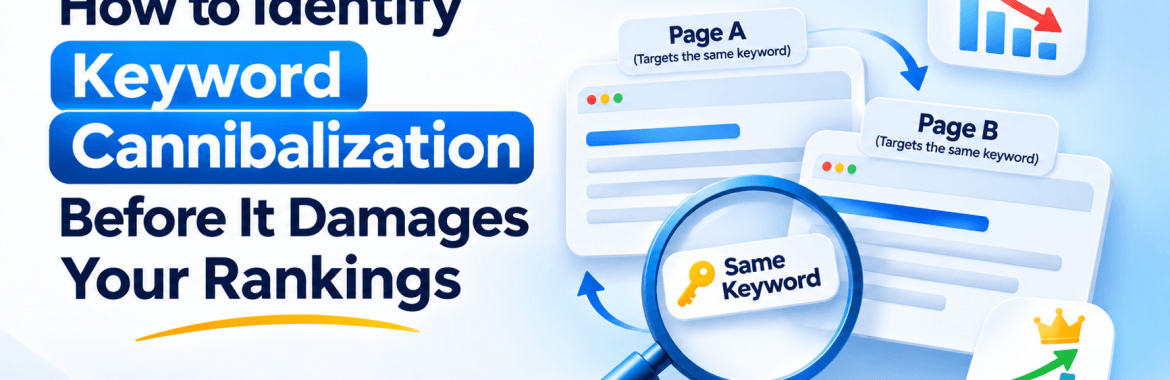
When two pages on your site answer the same search query, Google has to pick one, and the pick can change from week to week. Rankings slip, links split between URLs, and a blog post can outrank the page meant to bring in enquiries. Search Console shows the problem fastest: filter by a query, open the Pages tab and check whether more than one URL appears. A site search, a title and H1 audit and a review of your internal anchor text confirm what the data suggests. Once you know which pages overlap, the fix is a merge, a 301 redirect, a change of focus on one page or a correction to internal links. Our team at Infinix, a Digital Marketing agency in Chennai, runs this review at the start of every SEO engagement. The sections below follow that order.
What Keyword Cannibalization Does to Your Rankings
Google ranks individual pages, so two URLs that answer the same query compete directly. Take a Chennai dental clinic that publishes a service page and a blog post, both optimised for “dental implant cost.” One week the service page sits at position 9. The next week the blog post replaces it at position 11. Backlinks and internal links are divided between the two, and neither page builds enough authority to hold a first-page position.
The business also loses conversions. When the blog post outranks the service page, visitors land on an article instead of a page built to collect enquiries.
Warning Signs You Can Spot Without Special Tools
These signs usually show up first:
- Search Console lists two or more URLs with impressions for one query.
- The URL ranking for a keyword switches between pages from one week to the next.
- A page holding a stable position falls soon after a similar article goes live.
- A blog post ranks for a commercial query where the service page should.
- Several pages have title tags or H1 headings that begin with the same phrase.
How to Identify Keyword Cannibalization in Five Steps
Step 1: Check Query and Page Data in Google Search Console
Open the Performance report, select one query as a filter and click the Pages tab. If two URLs both collect impressions for it, they are competing. Pull three to six months of data, then sort queries by the number of URLs they return. Ignore queries with only a handful of impressions, because the sample is too small to judge.
Step 2: Run a Site Search for Your Target Phrase
Search for site:yourdomain.com followed by your keyword in quotation marks. Pages at the top of the results that use the phrase in their titles and headings are candidates for overlap. This check takes minutes and suits websites with a few hundred URLs or fewer.
Step 3: Audit Titles, H1 Headings and Meta Descriptions
Crawl the site with a tool such as Screaming Frog and export every title and H1. Sort the list alphabetically so pages with the same lead phrase sit together. We flag any group of three or more URLs built around one primary keyword, since that pattern rarely reflects deliberate planning.
Step 4: Review Internal Anchor Text
Suppose you link to three different pages using the anchor text “SEO services in Chennai.” Each link tells Google that its target is the answer for that phrase. Assign one anchor phrase to one page and change the rest.
Step 5: Compare Search Intent Before You Act
Shared vocabulary does not always mean competition. A guide titled “What Is Keyword Cannibalization” and a service page for an SEO audit can use similar terms because one serves informational intent and the other commercial intent. Search the keyword and read the live results. If Google shows the same type of page for both queries, the intent is shared and the pages need to be consolidated or differentiated.
Which Conflicts to Fix First
Start with pages that generate revenue. A conflict affecting a service page that brings in enquiries deserves attention before one affecting a blog post with 20 monthly visits. The usual action depends on the situation:
- Same intent, one page weak with few backlinks: merge it into the stronger page and apply a 301 redirect.
- Same intent, both pages with strong backlinks: consolidate the content, redirect one URL and ask linking sites to update their links.
- Different intent, similar keywords: leave both pages live. Change the titles and H1 headings so each page names its own topic.
- Blog post outranking a service page: Add an internal link from the blog to the service page. Make sure the blog is focused on answering information based searches.
- Outdated duplicate with no traffic: delete it, or add a noindex tag.
What to Monitor After the Fix
Redirected URLs take time to be recrawled, so wait four to eight weeks before you judge the result. In Search Console, check which URL now ranks for each target query and compare its clicks and impressions with the figures from before the merge. A position that still moves between pages after eight weeks usually means a redirect or canonical tag is set up wrongly, or internal links still point to a retired URL.
How We Audit for Keyword Cannibalization at Infinix
At Infinix, we build a keyword map before any content goes live. Every target phrase is assigned to one URL, and each new content brief is checked against that map. For existing websites, we start with the Search Console export, crawl the site, review intent in the live results and deliver a prioritised list of merges, redirects and rewrites.
Conclusion
Keyword cannibalization develops quietly as a website grows, and the damage shows up as unstable rankings, split links and lost enquiries. Search Console data, title audits, anchor text reviews and intent checks identify it early, and a clear fix for each conflict restores one strong page per query. If you want an SEO company in Chennai to review your site for overlapping pages and give you a prioritised fix list, contact Infinix.
What is keyword cannibalization in SEO?
It is the situation where several pages on one site target the same query and the same intent. Google picks one to show, and that choice can change between crawls, which weakens the position of every page involved.
Does keyword cannibalization always hurt rankings?
No. A guide and a service page can share keywords and rank together when they serve different intents. Trouble starts when both answer the same question, because Google then switches between them and neither holds a steady position.
How do I find keyword cannibalization in Google Search Console?
Filter the Performance report by one query, then open the Pages tab. If two URLs each show a meaningful number of impressions, review both.
Should I delete or merge cannibalizing pages?
Merge them when both hold useful content or backlinks. Move the best material into the stronger URL and 301 redirect the other. Delete only pages with no traffic, no links and no use to a visitor.
How long does recovery take after fixing cannibalization?
Most sites see rankings begin to stabilise within four to eight weeks, depending on crawl frequency and how many pages were affected.
How often should I audit for keyword cannibalization?
Audit every quarter, and run an additional check whenever you publish a content batch or launch a new service page.