
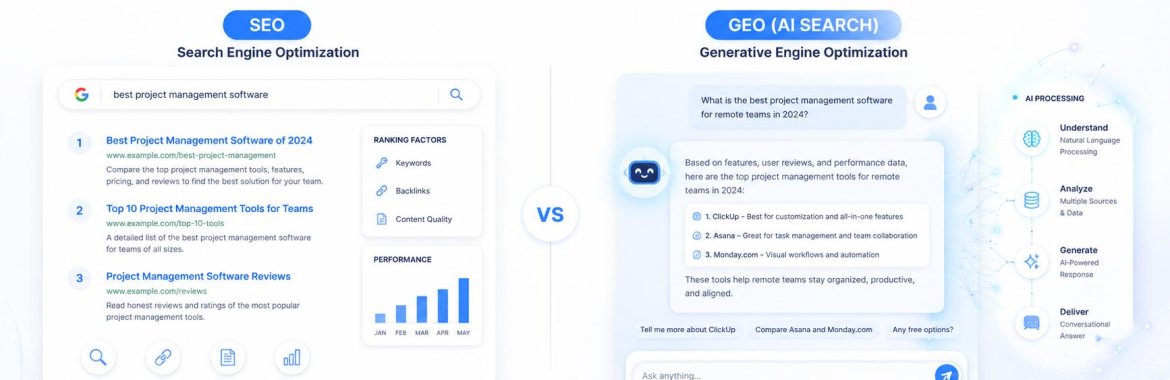
Search behavior is changing faster than the algorithms used to track it. For a long time, the goal was simple: rank on the first page of Google. Now, we are entering an era where the search engine doesn’t just point to a website; it answers the question directly. The move from Search Engine Optimization (SEO) to Generative Engine Optimization (GEO) is forcing every Digital Marketing agency in Chennai to rethink how they manage client visibility. Traditional blue links still exist, but they are no longer the primary finish line.
The Realities of the Search Shift
Traditional SEO has always operated on a pull-and-push model. A user searches for a term, and the engine serves up a curated list of pages it deems relevant. We used to measure success by clicks and impressions. But GEO, or AI search optimization, changes the interaction entirely. Platforms like Google’s SGE, Perplexity, and SearchGPT don’t just find information; they synthesize it into a single, cohesive answer.
This creates a “zero-click” environment. When the AI answers the user’s question on the results page, the motivation to visit your site disappears. This isn’t a death sentence for traffic, but it is a massive shift in how we define value. The goal now is to be the “source of truth” that the AI relies on to build that answer.
GEO vs SEO: Defining the Divide
SEO and GEO might target the same user, but the mechanics are fundamentally different. SEO is a battle for placement. You adjust metadata, secure high-quality backlinks, and optimize for technical performance so an algorithm ranks you as the most relevant link in a list. It’s about being “chosen” by the user from a menu of options.
GEO is a battle for inclusion. When a generative engine builds an answer, it isn’t looking for a page to recommend; it’s looking for data to absorb. If you aren’t providing the specific metrics or authoritative statements that the model can parse, your brand is excluded from the summary. In this new landscape, the future of search engine optimization is less about technical checkpoints and more about your brand’s presence in the training data and live search index. If the AI doesn’t mention you in a summarized “Top 10” list, your page-one ranking in the blue links below becomes largely irrelevant to the user’s journey.
The New Mechanics of Influence
To win in generative search, you have to stop writing “about” a topic and start providing the raw data points that fuel the answer.
- Own the Data Source: Generative engines need a primary source to anchor their claims. If your content uses vague “industry experts say” phrasing, you are invisible. Use explicit ownership: “Our Q1 2024 analysis of 10,000 lead forms confirms…” This forces the engine to attribute the insight directly to your brand.
- Anchor with Hard Numbers: Adjectives don’t exist to an LLM trying to summarize a trend. “Fast growth” is noise. “A 40% reduction in churn over six months” is a citeable fact. The more specific your metrics, the higher the probability that an AI will extract your sentence as the definitive answer.
- Clinical Neutrality: Marketing fluff acts as noise during LLM synthesis. Engines prioritize information that reads as objective documentation. If your writing is overloaded with superlatives and “world-class” claims, the AI will likely strip those away and find a simpler, more technical source to summarize for the user.
The Problem with Traditional SEO Metrics
We are reaching a point where “position 1” might be hidden behind a “Show more” button in an AI-generated panel. Businesses that cling to monthly traffic reports as their only KPI will miss the bigger picture. In GEO vs SEO, the win is no longer just the click; it’s the brand mention. When a user asks an AI for a recommendation, and the AI mentions your product by name, that is a high-intent lead, even if they didn’t land on your homepage immediately.
Preparing for AI Search Optimization
To stay visible, you need to abandon the idea that keywords alone drive value. Generative engines are looking for specific structures that help them build answers.
- Solve for Multi-Layered Intent: AI queries are rarely simple. People use generative tools to navigate specific obstacles, not just to find definitions. If your content ignores the “if/then” variables of a problem, it won’t be indexed as a solution. High-level summaries are losing ground to content that addresses restrictive or conditional scenarios.
- Hard-Code Your Facts: Schema markup is the engine’s map. Without clear, structured data, the AI has to guess your prices, locations, and services. If it guesses wrong or can’t find the data quickly, it will simply move on to a competitor with cleaner code. This is the new baseline for AI search optimization.
- Include Verified Expert Insights: AI prioritizes content that it can link back to a real person or a known authority. Adding a verified bio or a quote from a senior consultant isn’t just a design choice; it’s a technical signal that your content is a safe “source” for the engine to use.
Beyond the Algorithm: Real-World Content Utility
The web is currently drowning in mid-tier content. As AI models scrape the internet, they are increasingly encountering their own echoes—content generated by other AI. This makes original, primary-source data the new currency. If you aren’t publishing case studies, unique experiments, or proprietary data, you aren’t giving the generative engines anything new to synthesize.
We’re seeing a bifurcation in search. The future of search engine optimization suggests that searchers will use AI for “quick facts” but will still seek out human-verified, deep-dive content for high-stakes decisions. Your content needs to serve both. It must be structured enough for a machine to summarize, but nuanced enough that a human finds value once they click through to verify the AI’s claims.
Operational Changes for Generative Presence
Most businesses are stuck using a 2019 SEO framework that relies on narrative density. For a generative engine, that density is just friction. You need to change how information is tiered on your site.
- Remove Verbal Friction: Stop burying your value proposition in “creative” storytelling. Generative models operate on literal interpretation. If your service reduces energy costs by 22%, that needs to be the primary sentence of the paragraph. Lead with the outcome. If the AI has to read 400 words of background before finding a statistic, it will pull from a competitor who provided the data in the first header.
- Verify Your Cross-Platform Data: AI validates truth by checking multiple sources simultaneously. If your corporate website claims a different founding date or service list than your LinkedIn or Crunchbase profile, the model detects a confidence conflict. In the GEO era, data silos are technical liabilities. You must synchronize every public-facing mention of your brand to ensure the engine views your data as high-confidence.
- Inverted-Pyramid Data Delivery: Structure your pages so the extractable “truth” is at the top. This goes beyond SEO headers. It’s about ensuring that a scraper can pull a cohesive answer from the first two paragraphs without needing to analyze the rest of the page logic. If you make the engine work for the answer, you lose the citation.
Balancing the Two Worlds
Moving toward GEO doesn’t mean deleting your SEO plugins. The two are symbiotic. A technically sound website provides the “crawlability” that allows an AI engine to find your information in the first place. Without the foundation of traditional SEO, you won’t even be in the dataset that the AI uses to generate its answers.
Infinix focuses on this dual-path strategy. We recognize that while the tools are changing, the objective remains the same: being the most helpful answer to a user’s problem. Whether that answer is delivered as a link or a paragraph of AI text, your brand needs to be there.The rollout of Gemini and Apple Intelligence is already bypassing traditional search results. This isn’t a future scenario; it’s a present-day reality that demands a shift in how you document your brand’s expertise. Updating your SEO in Chennai strategy to include these generative signals is no longer optional if you intend to remain a cited authority in your industry.