
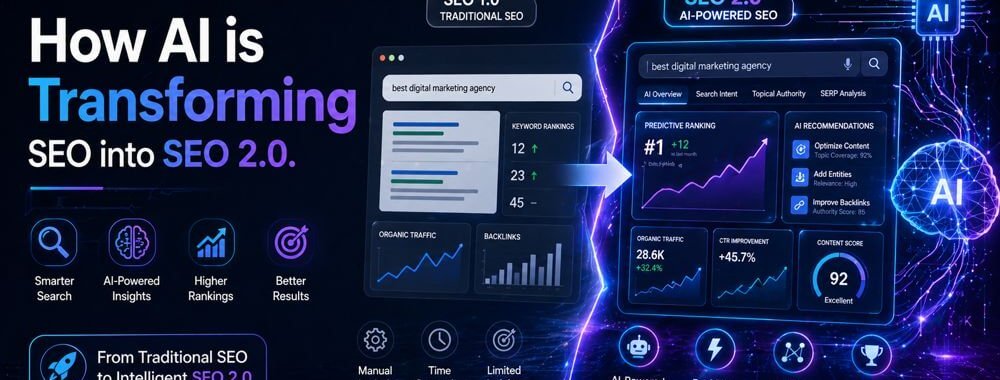
Search engine optimization is no longer about matching strings of text to a database. We are currently witnessing a total overhaul of the search landscape, moving away from the traditional blue-link results toward a more conversational, generative experience. For a business to survive this shift, partnering with an experienced SEO company in Chennai is becoming a necessity rather than a luxury. This transition marks the start of the SEO evolution, where the focus moves from simply ranking for a keyword to becoming the definitive source that an AI model trusts to cite.
The old playbook relied on high-volume keywords and repetitive backlinking. That approach is now obsolete. Google’s integration of AI Overviews and the rise of LLM-based search engines mean the algorithm is looking for depth, context, and entities rather than just optimized text.
The Core Shift: Moving Toward SEO 2.0
Traditional search was reactive. You typed a query, and Google showed you what it thought was the best match. SEO 2.0 is different because it is predictive and conversational. AI models now attempt to understand the intent behind a query before the user even finishes typing. This changes how we structure data.
If your website isn’t structured to be read by a machine learning model, you are invisible. We are seeing a move toward Generative Engine Optimization (GEO). This is where the AI in SEO becomes a double-edged sword. It allows for faster data processing, but it also means the bar for originality has been raised significantly. AI-generated fluff is being filtered out at the source, while content that provides unique, human-verified insights is being elevated.
Understanding Search Generative Experience (SGE)
The most visible change is how Google presents information. AI-powered summaries now appear at the top of many search results.
- Users are getting their answers without ever clicking through to a website.
- Zero-click searches are becoming the standard for informational queries.
- The goal now is to be the source that the AI uses to generate that summary.
- Brand mentions in conversational queries are becoming as valuable as traditional rankings.
The Role of AI SEO Optimization in Technical Health
Manual audits are becoming a relic of the past. Today, ai seo optimization involves using machine learning to predict which technical errors are actually hurting your performance versus which ones are just noise. We use AI to analyze log files at a scale that was previously impossible. This allows us to see exactly how Googlebot is interacting with a site in real-time.
However, the risk is relying too heavily on tools. Many developers use AI to generate schema markup but fail to verify if that schema actually maps to the physical content on the page. In the world of SEO 2.0, this kind of disconnect results in an immediate loss of trust from the crawler. Your site needs to be a cohesive unit of information where the code and the content tell the exact same story.
Real-World Problems with Automated Content
We see it constantly. A brand uses an AI tool to generate 500 blog posts in a month. Initially, they see a spike in impressions. Then, a Helpful Content update hits, and the traffic vanishes. This is a classic example of failing to understand the future of SEO. Google is looking for E-E-A-T: Experience, Expertise, Authoritativeness, and Trustworthiness. An AI can summarize expertise, but it cannot demonstrate it.
The successful strategy involves using ai seo optimization to handle the heavy lifting, such as keyword clustering and intent mapping, while leaving the actual narrative and insight to humans. This is the only way to ensure your content has a soul that the algorithm can recognize.
Why Intent is the New Keyword
In the early days, you could rank for “best shoes” just by mentioning it enough times. Now, the SEO evolution has made the algorithm smart enough to know if you are looking for a review, a store, or a history of footwear.
- Navigational Intent: The user knows where they want to go.
- Informational Intent: They want an answer, which AI now often provides directly.
- Transactional Intent: They are ready to buy.
- Commercial Investigation: They are comparing options.
The future of SEO requires you to map every single page on your site to one of these specific intents. If a page tries to do too much, the AI model won’t know where to categorize it. This lack of clarity is the primary reason many sites are losing their featured snippet spots to more focused competitors.
The Infrastructure of AI in SEO
The backend of your site is more important than ever. If your server is slow, the AI model might time out while trying to fetch your content. If your internal linking is a mess, the model will struggle to understand the relationship between your pages. This isn’t just about best practices anymore; it is about the physical limitations of how AI scrapes the web.
You need to prioritize:
- API-based indexing: Telling Google the second you have a new page.
- Vector search readiness: Ensuring your content is organized so it can be indexed into a vector database.
- Semantic HTML: Using tags that describe the content’s meaning, not just its appearance.
Adapting to the Future of SEO
We are moving toward a web where search is integrated into everything, from your glasses to your car. This means the context of a search, including location, time of day, and previous behavior, is being analyzed by AI in SEO to provide a personalized result. For businesses, this means ranking number one is a subjective metric. You might be the top result for a user in Chennai and the tenth result for someone in Mumbai for the exact same query.
Google is moving toward a search model based on trusted entities. If your brand lacks citation as a primary authority, AI models won’t take risks with your content when generating a summary for a user. Building this level of recognition requires more than just optimized text; it requires a documented history of accuracy and a clear identity that machine learning models can verify. It is a slow burn that automated tools simply cannot replicate.
Conclusion: Dominating the New Era
Generative search is a permanent change in how information is accessed, not a trend. If your site lacks technical readiness, search models will simply reference your competitors. This is the reality of the market right now. Surviving this shift requires a digital marketing company in Chennai that understands server-side logic and data schemas. The brands that win over the next decade will be the ones that stop treating SEO like a checklist and start treating it like a data science project. Content needs a human voice, but the backend needs to be flawless. If your technical setup is still stuck in the past, your organic traffic is already at risk.