
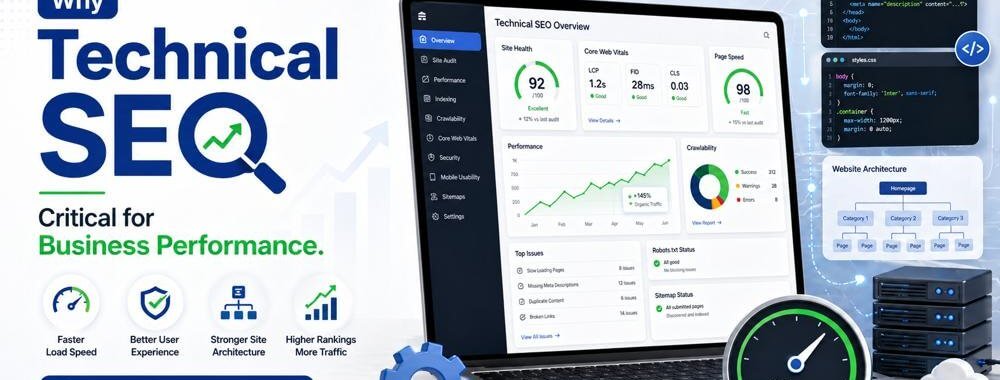
Most businesses treat their website as a visual storefront, but a site that looks perfect yet fails to rank is a wasted investment. When a marketing strategy relies on high-quality content without addressing the backend infrastructure, the content never actually reaches its audience because search engines cannot process the pages. For companies trying to gain traction in competitive markets, engaging professional SEO services in Chennai is often the only way to identify why their organic growth has stalled. The importance of technical SEO lies in its ability to remove the invisible barriers that prevent Google from cataloging your site’s value. If the code is bloated or the server is unresponsive, your marketing budget is effectively subsidizing a site that no one can find.
Search engine bots do not care about your color palette; they care about accessibility and efficiency. When you ignore the structural health of your domain, you are essentially asking search engines to work harder to understand your business. Most bots will simply move on. Ensuring every resource spent on your website translates into a readable signal for search algorithms is the primary objective here.
Important Components of Technical SEO
Getting the technical side of a website right requires looking at things developers often miss during the initial build phase. One of the most common issues is the crawl budget. Google only spends a limited amount of time on your site. If that time is wasted on broken links, duplicate pages, or long redirect chains, your new product pages might remain unindexed for weeks. Technical SEO optimization involves cleaning up these paths so the bot reaches the most important content immediately.
Crawlability and Indexing Efficiency
If a bot cannot reach a page, that page does not exist in the search results. It is that simple. This often happens because of poorly configured robots.txt files or accidental “noindex” tags left over from the development stage. You should also look at your XML sitemap. A messy sitemap that includes 404 pages or redirects confuses the crawler and suggests that the site is poorly maintained.
- Server Response Times: A slow server isn’t just a user experience problem. It is a crawlability problem. If the server takes too long to respond, the bot will reduce the frequency of its visits.
- Internal Link Logic: Deeply buried pages rarely rank. If a page is more than three clicks away from the homepage, it loses authority.
- Redirect Health: Avoid “chains” where one link leads to another, which leads to another. These waste time and dilute the ranking power of the original link.
Rendering and JavaScript Handling
Modern websites are increasingly built on JavaScript frameworks like React, which create a specific set of problems for search engines that are not equipped to render heavy client-side code in real time. If your content only appears after a series of complex scripts execute, there is a high probability that Google will index a blank page or a header-only version of your site. This is where the choice between client-side and server-side rendering becomes a business decision rather than just a developer preference. Technical SEO optimization for these types of sites involves pre-rendering content so that search bots receive a static version of the page, bypassing the script execution bottleneck entirely.
The Reality of Site Speed and User Experience
Speed is now the price of visibility, not a measure of the “best” sites. When Google launched Core Web Vitals, it codified the relationship between technical performance and ranking. If your layout shifts while a user is trying to click a button, or if the main content takes more than two seconds to become interactive, the bounce rate will punish your domain. This is not theoretical. High bounce rates signal to the algorithm that the site is failing the user, which triggers a drop in rankings that no amount of backlink building can fix. This realization is when the importance of technical SEO moves from a tech-department concern to a boardroom priority.
Mobile performance serves as the primary benchmark because Google crawls the web through the lens of a mobile browser first. A site that feels fast on a desktop fiber connection but stutters on a 4G mobile device will see its global rankings decline. This is not about having a “responsive” design; it is about the physical weight of your code and the processing power required to render it on a handheld device. If your site forces a phone to download and parse megabytes of unused CSS or JavaScript, you are effectively locking out a majority of your audience.
Business Impact and Growth Stability
The actual payoff for fixing backend errors isn’t just a clean audit report. It is a direct impact on your revenue. When you eliminate the lag and ensure the server responds instantly, you remove the subtle friction that kills a sale. Users rarely analyze why a site feels slow; they simply leave. This is where the primary technical SEO benefits materialize. A site that operates without glitches feels reliable, which is a fundamental requirement for any online transaction.
Beyond the immediate user experience, a clean site acts as a shield during major algorithm updates. While competitors who rely on content shortcuts see their traffic disappear overnight, a site with a stable technical foundation usually maintains its position. This predictability is among the most valuable technical SEO benefits for businesses that need to forecast their growth without worrying about sudden losses in visibility. Furthermore, your paid marketing becomes more efficient. When your landing pages are technically sound, your Quality Score in ad platforms improves, which directly lowers your cost-per-click.
Why Technical Debt Destroys Business Growth
Technical debt occurs when you prioritize quick fixes or flashy features over a clean backend. Over time, these small errors accumulate. A few broken redirects here and an uncompressed image library there might not seem like much, but they eventually slow the site to a crawl. In a competitive environment, your competitors are likely auditing their sites quarterly. If you aren’t, you are losing ground every day.
Ignoring the backend of your site is a business risk. It leads to “ranking cannibalization,” where Google can’t tell which of your pages is the most important because the site structure is confused. It also makes your site vulnerable to security threats. An unencrypted site or an outdated server configuration is an easy target, and once a site is flagged as “not secure,” recovering your search presence can take years.
Aligning Infrastructure with Performance
Infrastructure needs to evolve alongside your traffic. A site architecture that works perfectly for 10 pages often collapses under the weight of 1,000. If your internal linking logic is messy, search bots get trapped in loops or ignore your high-value subdirectories entirely. This is why scaling businesses rely on high-level digital marketing services in Chennai to align their server configurations with their revenue goals. You cannot fix structural rot with better copy.
Success in modern search requires a site that loads instantly and serves clean code to every bot that visits. By refining server headers, fixing script execution errors, and auditing your redirects, you protect the long-term viability of your domain. A fast, accessible site is a profitable site. Address your technical health today to avoid the massive recovery costs that follow a total collapse in organic visibility.