
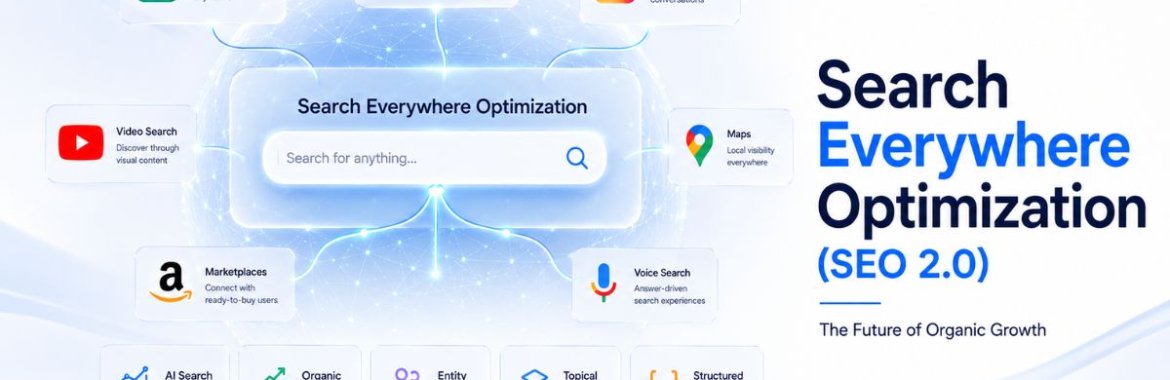
Something has shifted in how people actually search, and most brands haven’t caught up yet. Sure, Google is still where a lot of searches happen. But think about your own habits for a second. You ask ChatGPT what laptop to buy. You check TikTok before booking a restaurant. You search Amazon directly instead of Googling “best water bottle.” None of that shows up in a traditional SEO report, yet it’s exactly where customers are making decisions. Marketers have started calling thisSearch Everywhere Optimization, or SEO 2.0, and for any digital marketing agency in Chennai advising local businesses, ignoring it is no longer an option.
In this blog, we will take a closer look at what this shift actually means, why ranking on Google alone doesn’t cut it anymore, and what businesses should be doing differently.
One Search Engine Used to Be Enough. Not Anymore.
For years, SEO had a single obsession: get to page one of Google. That’s it. Marketers built careers around it, agencies sold packages around it, and honestly, it worked for a long time.
But look at how a purchase decision actually unfolds today. Someone sees a product mentioned in a Reddit thread. They watch a YouTube review to see it in action. They ask an AI assistant to compare it with two competitors. Only then do they Google the brand name, mostly to confirm it’s legitimate before checking out. Google was just the last stop, not the starting point. Each of those earlier touchpoints works like its own mini search engine, with different rules for what gets seen and what gets ignored. A business that only optimizes for Google is essentially invisible during most of that journey.
So What’s Actually Different About SEO 2.0?
This isn’t old SEO wearing a new label. A few things have genuinely changed, and they change how content needs to be built.
First, content has to answer the question, not just rank for it. Tools like Google’s AI Overviews and ChatGPT lift short, direct answers straight out of web pages, sometimes without the user clicking through at all. That means the old game of stuffing in keywords matters far less than writing something clear enough for an AI to pull out and quote correctly.
Second, every platform plays by its own rules, and pretending otherwise gets you nowhere. YouTube cares about watch time. Amazon cares about reviews and conversion history. An AI chatbot cares about how credible and well organized your source material looks. Treating all three the same way, with the same content and the same approach, is a recipe for mediocre results across the board.
Third, and this one surprises people, brand mentions without a link are starting to count for something. AI models are trained on huge chunks of the internet, and they pick up on patterns, like how often a brand comes up in forums, review sites, and casual conversation, and whether that context is positive. No backlink required. Just visibility and reputation, tracked in a way that used to be invisible to search algorithms entirely.
A few things businesses are actually doing about this right now:
- Rewriting service pages so they answer real customer questions in plain language, not marketing speak.
- Adding FAQ sections and structured data that AI tools can read and quote without confusion.
- Pushing harder for reviews and mentions on third-party sites instead of only publishing on their own website.
AI Isn’t Just a Tool Anymore. It’s a Gatekeeper.
Here’s the part that’s genuinely changing the game. When someone asks an AI assistant for a recommendation, they don’t get ten options to scroll through. They get one answer, maybe two. That’s the whole competition now, being the source that gets picked.
This flips the old incentive on its head. Instead of fighting for the top spot on a results page, businesses are now fighting to be the thing an AI decides to cite. And AI models are picky. They don’t reward vague claims or padded paragraphs the way a distracted human scrolling through search results might. Content needs to actually say something true and useful, or it gets skipped.
That also raises the stakes on accuracy. A page full of soft, unverifiable claims might have slipped by a human reader in 2020. It won’t hold up as a trusted source for an AI system in 2026.
None of this means Google stops mattering. It doesn’t. Technical basics like page speed, mobile usability, and clean site structure are still the foundation everything else sits on. What’s changed is the size of the picture businesses need to be optimizing for.
A strategy built for this moment treats every place a customer might search, whether that’s a search engine, a social platform, a marketplace, or an AI assistant, as its own channel with its own logic. It leans into clarity over volume. And it treats brand reputation across the wider internet as something that directly feeds visibility everywhere else, not as a nice-to-have.
The businesses building this kind of layered presence now are going to have a real advantage in a year or two. The ones still measuring success purely by Google rank may not even notice they’re losing ground until it’s already happened.
We’ve watched search behavior at Infinix change more in the past couple of years than it did in the decade before that, and honestly, it’s forced us to rethink parts of our own process too. We’re not interested in chasing every algorithm update for the sake of it. What we care about is building content that holds up no matter where a customer happens to be looking, whether that’s a Google search, an AI assistant, or some platform that barely existed a year ago. As a team handling SEO services in Chennai for businesses across different industries, this layered approach is exactly what we build toward, one that doesn’t fall apart the moment a single platform changes its algorithm. If your search strategy still starts and ends with Google, it’s worth a conversation.