
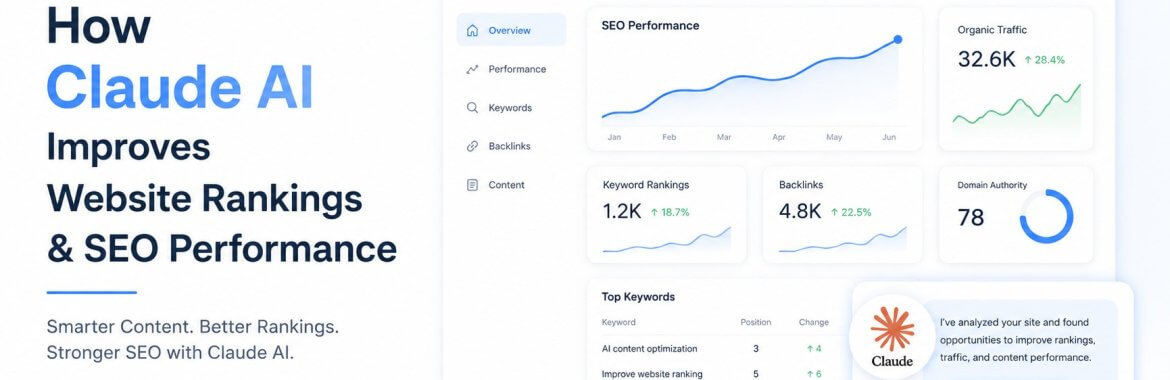
The era of simple keyword matching has ended as search algorithms have matured into systems that prioritize comprehensive topical authority over exact-match phrases. For anyone managing Digital Marketing in Chennai, the habit of mass-producing average content is a technical liability. We’ve seen traffic disappear because sites were still chasing old crawlers. Today, we use Claude to reverse-engineer how search engines actually value context. We aren’t just writing for bots. We are building structures that make it impossible for an engine to miss your authority.
The Reasoning Edge: Why Claude Differs for SEO
Most search specialists are familiar with basic AI generators, but Claude represents a shift from generation to reasoning. While other models might struggle with “hallucinations” or generic fluff, Claude’s long context window and superior logical processing make it uniquely suited for heavy SEO workloads. It doesn’t just write; it analyzes. When we feed a model like Claude 3.5 Sonnet the top 20 search results for a high-value query, it can identify the subtle thematic gaps that a human analyst might miss in a four-hour deep dive.
We recently analyzed a finance blog that was stuck on page two. Claude pointed out that while the text covered “how to save,” it ignored the psychological barriers to entry, like “debt anxiety,” which competitors were answering directly. We fixed that gap. The site moved up within weeks. This is the foundation of modern ai powered seo strategies. We’ve moved past the era where more words meant better rank. Today, the engine looks for topical completeness. Claude helps bridge that gap by identifying exactly which sub-topics are missing from a site’s architecture. It isn’t about tricking the system; it’s about providing the most comprehensive answer possible.
Real-World Intent Mapping with Claude
Keyword research has become a commoditized task. Anyone can export a CSV from Ahrefs or SEMrush. The difficulty lies in intent mapping: diagnosing why a user is searching and predicting what they expect to see next. Using Claude for seo allows us to categorize massive keyword datasets into logical intent clusters without the manual slog of spreadsheet tagging.
- Identifying Hidden Friction: Claude can scan a transactional keyword list and flag where searchers are actually expressing anxiety. If users are searching for “price” alongside “warranty” and “security,” the model highlights that your page isn’t failing on price, it’s failing on trust signals.
- Informational Pillar Discovery: The model identifies when a high-volume keyword is actually a signal for deep education. It suggests that a simple blog post should be replaced by a technical whitepaper to satisfy the “discovery” phase of the funnel.
- Competitive Data Parity: We use Claude to draft objective comparison data and feature lists. It looks for the specific data points that users demand before making a high-stakes purchase, ensuring your site provides the “truth” that competitors are omitting.
Mapping these clusters manually is a recipe for oversight. We’ve observed that when page logic directly mirrors the user’s specific friction points, bounce rates drop. Users stay because they found the one specific detail the AI extracted from a broader dataset.
Shifting Content Workflows from Volume to Value
The web is currently drowning in low-quality, AI-generated noise. Search engines have responded by raising the bar for “Helpful Content.” If your content reads like a standard generator output, it will eventually be suppressed. Effective ai powered seo strategies treat Claude as a senior editor, not a ghostwriter.
Instead of requesting a 1000-word block on a generic topic, we use the model to stress-test existing drafts. We look for logical gaps. We ask it to pinpoint where a real-world case study or a specific technical specification would validate a claim. This human-led approach keeps the brand voice intact while checking the boxes that search algorithms now prioritize.
Technical SEO and Semantic Logic
Technical SEO is often treated as a visual checklist of tags and speed scores. In reality, a crawler’s ability to index a page depends on how well the semantic data is “hard-coded.” Claude is exceptionally good at building complex JSON-LD Schema markup from raw page data.
Whether it’s product schema, local business details, or nested FAQ markups, Claude generates code that search crawlers can parse without ambiguity. This precision frequently determines whether a site ranks in the top three or is buried on page two. When the crawler doesn’t have to “guess” at the context because the structured data is perfect, visibility improves.
The Evolution of AI Tools for SEO
The market is consolidating around a few high-performance models. Most standalone AI tools for seo are just simplified interfaces for older systems. Claude’s API allows for a much tighter integration into actual agency workflows, specifically for deep-dive gap analysis.
- Extraction of Competitor Weakness: We feed Claude raw customer reviews from competitors to identify consistent service failures. We then optimize our client’s landing pages to highlight how they solve those exact pain points.
- Snippet Acquisition Tactics: Google often awards featured snippets to the most logically structured answer, not just the best page. Claude breaks down the exact syntax used by a competitor to hold that spot. It suggests the structural adjustments needed to provide a more authoritative definition that the algorithm finds easier to extract.
- Internal Link Equity Recovery: Internal linking usually breaks as a site grows. By processing crawl data, Claude identifies where link equity is trapped in isolated sub-sections. It suggests specific anchor text and placement to bridge these gaps, turning forgotten blog posts into active support for your main money pages.
Overcoming Tool Fatigue
Most agencies are overwhelmed by the sheer number of available AI tools for seo. The secret isn’t using more tools; it’s using the right one more deeply. Claude’s ability to handle massive documents, up to 200,000 tokens, means you can upload an entire website’s content audit and ask for a strategic roadmap. This isn’t a generic summary; it’s a data-driven plan based on the actual performance metrics of your domain.
Content Refreshing: The Forgotten SEO Tactic
One of the most effective ways to use Claude for seo is in the “content refresh” cycle. SEO isn’t a “set it and forget it” task. Rankings decay as information becomes outdated. We use Claude to compare year-old articles against the current top-ranking results. It identifies where statistics are stale, where new search trends have emerged, and where the “searcher’s journey” has shifted.
Information dies fast on the web. A guide to tax laws from 2022 is a liability in 2024. We don’t just update the year; we feed Claude the new regulations and ask it to find where our old advice contradicts current legal reality. It’s a technical audit of truth. Refreshing an old post with updated data and better structural logic is often faster and more effective than writing a new one from scratch. We’ve seen “dead” pages jump from page three to page one after a Claude-assisted refresh that took less than thirty minutes of human oversight.
Precision vs. Generalization
Treating Claude as a simple output generator is a mistake that leads to generic, low-ranking content. The tool is a diagnostic instrument. Vague directions result in vague visibility. To get results, you have to treat the model as a senior consultant rather than a copywriter.
Effective use involves providing strict logical constraints and technical parameters. If you don’t define the target audience’s specific anxieties or the technical limitations of the industry, the model will default to a safe, neutral average. We use detailed personas and specific data payloads to ensure the output matches the expertise expected in the local market. Precision in direction is the only way to avoid the “AI-generated” footprint that search engines now actively filter out.
Adapting to the Generative Era
We are moving into an era of “Search Generative Experience” (SGE). Search engines are now synthesizing their own answers at the top of the page. To be the source that the engine cites, your content must be logically sound and data-rich. Claude helps us audit our content for “citeability.” It looks for the hard facts, the unique observations, and the authoritative tone that makes a piece of content worth referencing by a generative engine.
Future-Proofing Through Experience
Manual penalties often follow aggressive “hacks” or shortcuts that ignore the end-user. Claude allows us to aggregate vast sets of behavioral data, identifying where searchers abandon a page or leave a query unsatisfied. By using these insights to address actual information gaps, we build a foundation that survives algorithm updates.Search is becoming an ecosystem of data synthesis rather than a simple index. The winners won’t be those who churn out more content but those who use AI to become more precisely human in their strategy. Claude handles the extraction and categorization, but the high-level decision-making remains with the specialist. Brands that treat Claude as a tactical crutch will lose visibility as search engines prioritize deep, verifiable expertise. Working with SEO companies in Chennai that understand the difference between generation and reasoning is the only way to protect your rank in a generative landscape.