
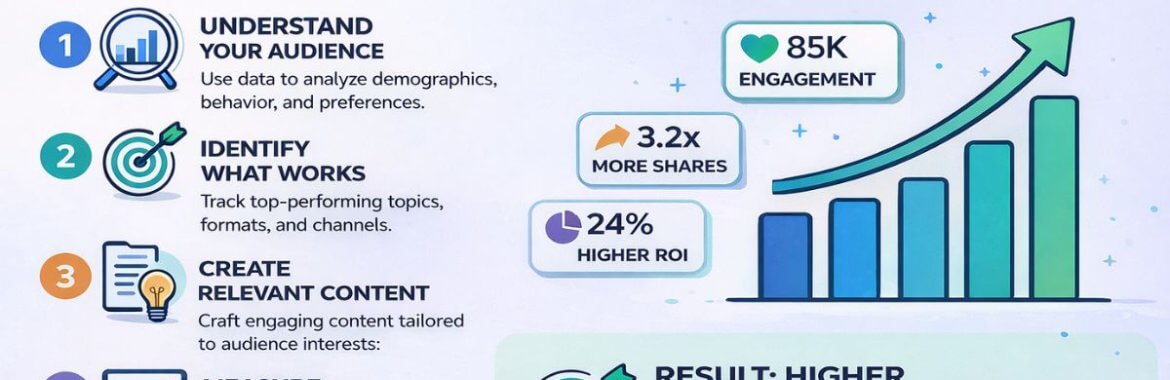
A lot of content gets published every day that nobody reads. Businesses pour hours into blog posts, social captions, and newsletters that look polished but fail to connect with anyone because they were built on assumptions instead of evidence. That is the gap between content that fills a calendar and content that moves a metric. The fix is surprisingly simple: look at what your audience is already searching for, check what has worked before, and use those numbers to decide what to write next instead of brainstorming in a vacuum. If your content has been consistent but engagement has stayed flat, a provider of digital marketing in Chennai like infiniX360 can help you shift from guesswork to a content optimization strategy that actually produces results.
Why Most Content Underperforms
The reason most content does not get traction is not bad writing but bad targeting. A well-written article about a topic nobody is searching for will sit at zero views indefinitely, while a decently written piece on a topic with real search demand can bring in traffic for months. The difference between the two has nothing to do with talent and everything to do with whether anyone used data before deciding what to write.
Businesses that skip the research step tend to fall into a pattern: they create content based on what they want to talk about rather than what their audience is actively looking for. The marketing team writes about product features, company news, and industry jargon that means something internally but does not match the way their customers think or search. Over time the blog fills up, the social feeds stay active, and the analytics dashboard shows nothing worth celebrating.
Data based content planning flips that by starting with what people are already searching for, clicking on, and engaging with, and then building content around those signals instead of internal priorities.
What Data-Driven Content Strategy Actually Looks Like
Using data does not mean staring at a spreadsheet for three hours before writing a paragraph. It means checking a few things before you commit time and budget to a piece of content.
The first thing to look at is search demand. Tools like Google Search Console, Ahrefs, or even Google’s autocomplete suggestions can tell you what your audience is typing into the search bar every month. If a topic gets 2,000 monthly searches and you have a genuine angle on it, that is worth writing about. If it gets 20, it probably is not, unless it targets a very specific buyer who converts at a high rate.
You should also look at competitive gaps by reviewing what your competitors have published and figuring out where they are thin. Maybe they covered a topic superficially, or maybe they missed a subtopic entirely, and that gap is your opening because Google rewards depth and originality over repetition.
Your own historical performance is equally worth looking into because your analytics will tell you which past pieces brought in traffic, which ones earned backlinks, and which ones led to conversions. Patterns will start to emerge: maybe long-form guides outperform short posts on your site, or maybe posts with data tables get shared more than posts without them. Whatever the pattern is, build more of what has already proven itself and less of what has not.
Improve Engagement with Data Driven Content
Engagement is not just about getting someone to click but about holding their attention once they arrive and giving them a reason to take the next step, whether that is reading another page, signing up, or making a purchase.
When you know which topics your audience searches for most often, you can write headlines that match their language instead of guessing at what sounds clever. Content that mirrors the way people actually phrase their questions tends to earn higher click-through rates from search results because the user sees their own words reflected back at them.
Once someone lands on the page, data tells you how long they stay, where they drop off, and what they click next. If your average time on page is under forty seconds on a two-thousand-word article, the problem is not length but structure. Breaking content into scannable sections, adding visuals at drop-off points, and front-loading the most useful information are all content optimisation decisions that come directly from behavioural data rather than editorial instinct.
Data based content planning also helps you figure out when to publish and where to distribute. If your LinkedIn posts get twice the engagement on Tuesday mornings compared to Friday afternoons, that is useful information that costs nothing to act on. If your email open rates spike when the subject line includes a number, do more of that. These are small adjustments, but they compound over weeks and months into noticeably better performance.
Tracking content trends in your industry also keeps you from publishing stale material. What worked as a topic eighteen months ago may have already been covered by every competitor in your category, and repeating it now adds noise rather than value. Monitoring trending queries, seasonal shifts, and emerging subtopics gives you a window to publish before the market gets saturated, which is when content earns the most links and shares.
Turning Data into a Repeatable Process
The businesses that get the most out of data-driven content are the ones that build it into their workflow rather than treating it as a one-time exercise. That means running a content audit at least once a quarter to identify what is working, what needs updating, and what should be removed entirely. It means checking search trends before finalising next month’s content calendar instead of brainstorming topics from scratch every time. And it means reviewing performance data after every piece goes live so the next one is a little sharper.
A content optimisation strategy is not about producing more but about producing smarter. One well-researched, data-backed article that ranks on page one and brings in steady traffic for a year is worth more than twenty posts that nobody finds, and the companies that understand this tend to publish less frequently but see better returns on every piece they put out.
Paying attention to content trends also keeps your strategy from going stale. Audiences shift, search algorithms update, and the topics that drove traffic last year may not carry the same weight today, which is why ongoing content optimisation and regular performance reviews help you spot these shifts early and adjust before your competitors do.
Making Data Work for Your Content
Content without data behind it is a coin flip. Sometimes it lands, most of the time it does not, and you never quite know why. When you bring search data, audience behaviour, and performance metrics into the planning process, you stop guessing and start building on evidence. The result is content that ranks better, holds attention longer, and converts more consistently.
If your content has been active but your engagement numbers have not kept pace, the issue is almost certainly in the planning stage. A provider of SEO services in Chennai like InfiniX360, with over 13 years helping 500+ businesses grow through search, can help you build a data-driven content process that turns publishing into measurable growth instead of a box you check every week.
Leave a Reply