
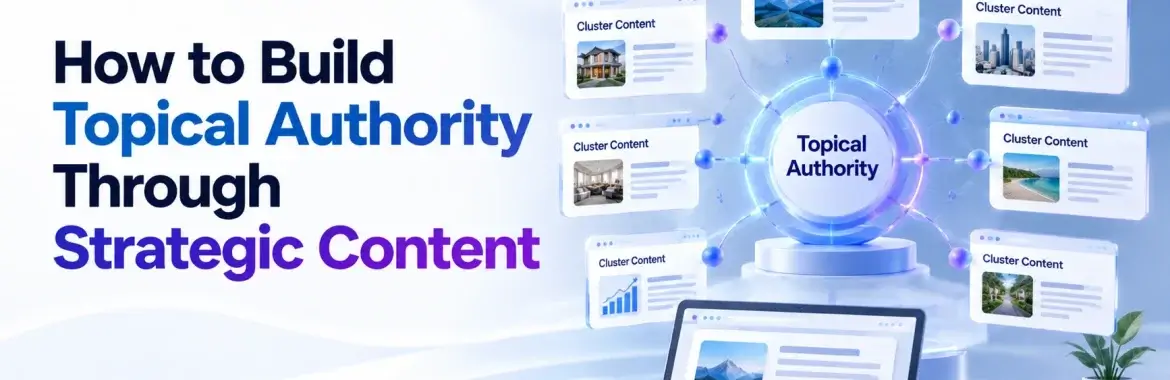
A site publishes forty blog posts on forty unrelated keywords and still loses to a competitor with fifteen pages on one subject. We see this pattern in content audits often. Topical authority comes from covering a single subject completely, organising those pages so search engines can follow them, and showing that people with real experience wrote them. At Infinix360, our SEO services in Chennai begin with a topic map, and this article follows the same order: choosing a topic and setting its limits, researching the questions inside it, structuring pages and internal links, writing with visible expertise, covering local and AI-generated search results, and measuring progress at topic level. Answers to common questions close the article. The sections below take each stage in detail.
Choose a Topic You Can Cover Completely
Search engines assess authority at topic level, so the first decision is which topic your site will own. Pick one that connects directly to what you sell. A Chennai interior design firm has a stronger claim on “modular kitchen design” than on “home décor trends”, because it can publish its own projects, costs, and material choices for the first.
Set the boundary before writing anything. We list every subtopic a buyer needs to understand the subject, from planning and pricing to maintenance and frequent mistakes. A mid-sized topic usually produces 25 to 40 pages. If your team cannot produce that many yet, start with the ten subtopics closest to a purchase decision and add the rest over time.
Research the Questions Buyers Actually Ask
Keyword tools show volume but rarely show gaps. We combine three sources: the queries your site already appears for in Google Search Console, the People Also Ask and related searches sections of the results page, and the questions your sales team hears on calls. The third source produces the most useful pages, because it records the exact doubts that delay a purchase.
Each question needs a page format that matches its intent.
| Search intent | Page format | Example for a Chennai dental clinic |
| Learning | Guide | How dental implants are placed |
| Comparing | Comparison article | Dental implants versus bridges |
| Pricing | Cost page | Dental implant cost in Chennai |
| Choosing | Service page | Dental implants at our clinic |
One page should target one primary intent. Two pages written for the same query compete in the results, and Google usually ranks neither as well as it would rank a single stronger page.
Build a Structure Crawlers Can Follow
Each topic needs one main guide and a set of detailed pages beneath it. The main guide gives a complete overview and links to every detailed page. Each detailed page links back to the guide with descriptive anchor text and to two or three related pages. A clean URL path, such as /dental-implants/cost/, confirms the relationship.
Internal links carry most of the weight here. A detailed page that no other page links to receives little attention from crawlers, however well it is written. We also add FAQ and Article structured data where the content supports it, since this gives search engines the page’s purpose in a format they can read directly.
Write With Visible Experience and Expertise
EEAT is judged on the page, and generic overviews fail it. A guide to kitchen cabinet materials that lists price ranges taken from your own quotations contains information a summary of other websites cannot match. Every page in the topic should show what its author actually knows:
- An author name that links to a page listing qualifications and years of practice
- Figures from your own projects, such as turnaround time or a typical cost range
- Photos, screenshots, or documents from real work
- A review date, with a note whenever figures change
Cite outside sources only when they add something, and name them. Vague references to “studies” weaken a page.
Cover Local Searches and AI-Generated Answers
Local relevance comes from specifics. A page for Adyar, Velachery, or T. Nagar needs content about that area, such as the projects completed there, the travel time to your location, and the questions customers from that area ask. Pages that repeat the same text with a different place name add nothing. Keep your business name, address, and service descriptions identical across your website and Google Business Profile.
AI Overviews and similar features draw from passages that answer a question directly. Place a plain answer of 40 to 60 words beneath each question heading and develop the detail after it. Pages written this way give those systems a clear passage to quote, and they read better for people who want the answer first.
Measure Authority at Topic Level
A single keyword position says little about authority. We group each topic’s pages in Search Console and watch four figures: total impressions, the number of queries ranking between positions 4 and 20, indexed pages, and internal links per page. Gains across a full topic build over several months, so we report on page groups instead of individual keywords.
Pages that lose clicks get updated, and new queries that appear in Search Console become new pages inside the same structure.
Conclusion
Topical authority depends on complete coverage, a clear page structure, visible expertise, and measurement at topic level. Content marketing services in Chennai that start with a topic map and report on page groups give a website the structure search engines need to treat it as a reliable source on its subject.
Frequently Asked Questions
What is topical authority?
Topical authority is the degree to which search engines treat your site as a dependable source on a subject. It rests on how fully you cover the topic, how consistently the pages connect, and how clearly real expertise stands behind the content.
How many articles does a topic need?
The number depends on the topic. Most service-based topics need between 15 and 40 pages to cover every buyer question, and you can begin with the ten pages closest to a purchase decision.
How long does it take to see results?
New pages typically begin earning impressions two to three weeks after indexing. Topic-wide gains take three months in narrow niches and six months or more in crowded categories such as real estate or digital marketing.
Do backlinks still matter?
Yes. Topical coverage and backlinks work together, because complete, well-structured pages are easier to earn links to and pass that authority through internal links.
Can a small local business build topical authority?
A small business can build it on a narrow topic. A single-location clinic that covers one treatment in full, with local detail and real case information, is a better candidate than one that publishes broadly on health.
How do I stop my pages from competing with each other?
Assign one primary query to each page and check Search Console for queries where two of your URLs appear. Merge overlapping pages into the stronger one and redirect the weaker URL to it.