
Two businesses in the same Chennai neighbourhood, offering nearly identical services, can see wildly different search visibility despite similar websites and similar ad spend. The variable that explains most of that gap rarely shows up in an SEO audit at all; it’s sitting quietly in the reviews tab.
This blog looks at how much weight customer reviews and online mentions actually carry in search visibility, both in traditional Google rankings and increasingly in how AI-driven search tools decide what to recommend. Working with a digital marketing agency in Chennai that treats reputation as a ranking factor, not just a trust signal, tends to reveal gaps that pure technical SEO work never surfaces on its own.
Why Reviews Stopped Being Just About Reputation
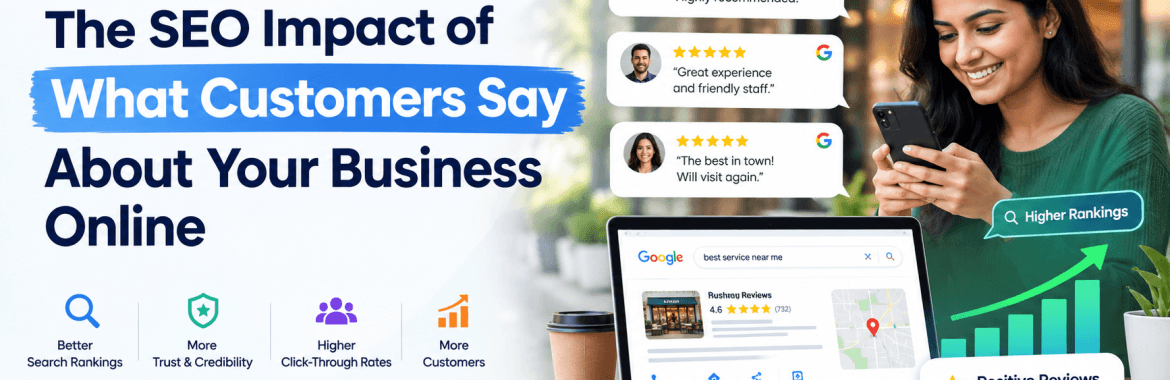
For a long time, reviews were treated as a trust signal for customers browsing a listing, not something that meaningfully affected search rankings themselves. That’s no longer an accurate way to think about it. Review volume, recency, and content now feed directly into how Google’s local algorithm ranks a business, and increasingly into how AI assistants decide which business to recommend when someone asks for a suggestion rather than a list of links.
This shift happened quietly enough that a lot of business owners are still operating on outdated assumptions, treating review management as a customer service task rather than a search visibility one. The businesses that noticed the change early are the ones now showing up consistently in both Google’s local pack and AI-generated recommendations, while competitors still wonder why their technically sound websites aren’t converting into the visibility they expected.
How Google Actually Uses Review Signals
A few specific factors tend to carry real weight in local search rankings:
- Review volume relative to competitors, since a business with considerably fewer reviews than nearby competitors often reads as less established, even if service quality is comparable
- Recency, since a steady stream of recent reviews signals an active, currently operating business more convincingly than a cluster of reviews from years ago
- Response rate, particularly to negative reviews, which search engines and customers both interpret as a sign of active management
- Keyword presence within reviews, since customers naturally mention specific services, dishes, or neighbourhood details that reinforce relevance for related searches
Not one of these factors works in isolation. A business with high review volume but no responses, or frequent responses but stagnant review growth, tends to underperform compared to one managing both consistently.
Why AI Search Tools Weigh This Even More Heavily
This is where the shift becomes harder to ignore. AI assistants and AI-generated search summaries don’t just crawl a website, they draw on the broader pattern of how a business is discussed across forums, review platforms, and casual online mentions. A business mentioned positively and consistently across third-party sites builds a kind of reputation signal that doesn’t require a single backlink to matter.
This means a business could have a technically flawless website and still be invisible in AI-generated recommendations if its presence across review sites, forums, and social mentions is thin or inconsistent. The AI isn’t reading a website in isolation, it’s reading a business’s reputation as it exists across the internet as a whole.
The Compounding Effect Over Time
Reviews and mentions don’t work like a one-time optimization task. A steady, ongoing flow of truthful feedback from consumers accumulates over months and years in a manner that a short-term review push can never quite match. When review collection is seen as a one-off campaign, rather than an ongoing effort, companies often see their visibility plateau, while their competitors with consistent momentum continue to outpace them in both traditional rankings and AI-driven recommendations.
What Businesses Should Actually Be Doing
A few practical habits tend to move the needle more than any single campaign:
- Asking satisfied customers for reviews consistently, as part of a routine process rather than an occasional push
- Responding to every review, positive and negative, in a way that reads as sincere rather than templated
- Monitoring mentions across forums, social platforms, and industry-specific review sites, not just Google
- Encouraging reviews that naturally mention specific services or products, rather than generic praise alone
- Addressing negative feedback directly and visibly, since how a business handles criticism often matters more than avoiding it entirely
The Risk of Cutting Corners Here
Incentivised or fabricated reviews carry real risk, both from a policy standpoint and a long-term trust standpoint. Search engines have become considerably better at detecting unnatural review patterns, sudden spikes, repetitive language, accounts with no real connection to the business, and flagging them accordingly. A business caught relying on manipulated reviews risks far more than a ranking dip, it risks the kind of suspension or trust penalty that takes considerably longer to recover from than it took to build the fake reviews in the first place.
Making Reputation Work as Hard as Your Website
We’ve watched review signals move from a soft trust factor to a measurable ranking input over the past few years at Infinix, and it’s changed how we approach search strategy for clients. Reputation work isn’t treated as separate from technical SEO, it’s built into the same strategy, since a technically perfect website with a thin review profile increasingly underperforms one with a strong, consistently managed reputation across the wider internet.
For businesses looking to build this kind of layered visibility, working with SEO companies in Chennai that treat reviews and reputation as core ranking factors, not an afterthought bolted onto a technical audit, tends to close the exact gap that pure website optimisation leaves open.
That restaurant owner eventually caught up, not by rebuilding the website again, but by making review requests part of every satisfied customer interaction and responding to every piece of feedback within a day. Within a few months, the ranking gap that had felt unexplainable started closing, not because the website changed, but because the reputation behind it finally did.
Frequently Asked Questions
1. Do online reviews actually affect Google rankings?
Yes, local search algorithms will include things like number of reviews, recency and how often the business responds to reviews.
2. Can AI search tools find reviews off my website?
Yes. Most AI assistants are trained to find reviews and mentions of a business on the wider web and its own website.
3. Is it risky to encourage customers to leave reviews?
Not when done properly. Asking satisfied customers for honest feedback carries no real risk, the concern lies specifically with incentivised or fabricated reviews, which search engines are increasingly good at detecting.
4. How quickly should a business respond to a negative review?
Within a day or two, ideally. Both the speed and the tone of a response shape how the interaction reads to anyone else reading it later.
5. Does Infinix provide online reputation management in SEO services for companies?
Yes. Our review and reputation strategy is part of the overall SEO framework that we build for our customers. It is not an add-on.